What Is Self-esteem? and How Counselling Can Help?
Self-esteem refers to how we see ourselves and the beliefs and opinions we have about ourselves. It can be thought of as being on a continuum from low to high and often you may experience fluctuations in self-esteem depending on how confident and capable you feel in any situation.
Low self-esteem is often something that people who enter counselling know that they struggle with and yet it can be a concept that is difficult to define. This gives self-esteem an elusive quality, something that’s difficult to obtain, as something that is out of reach.
What Causes Low Self-Esteem?
The reason people have low self-esteem will be different for everyone but might be a response to how you learned to gain approval from others or a reaction to people directing criticism your way or feeling as though problems in your life are somehow to be expected because of who you are.
Many people with low self-esteem are outwardly capable, responsible, or successful, yet privately doubt themselves. Self-esteem is really about how you see yourself, if this is negative you might also get tied up assuming other people have negative judgements about you (with little or no evidence). If this goes unchallenged, then your self-esteem is dependent on external validation. Children learn ways to behave that gain approval from their parents which naturally aligns us with the ability to monitor the reactions of others and know what will gain approval and positive attention. Over relying on external sources of esteem leaves you vulnerable because it can be taken away at any time. Stepping outside of this framework and focusing on what really matters to you can feel scary, especially if it is less socially acceptable.
How Low Self-Esteem Affects Daily Life
If you experience low levels of self-esteem you might have beliefs about yourself that can hold you back, maybe you feel like you shouldn’t try because you’ll just fail. You might lack confidence in social situations, so you increasingly avoid putting yourself out there.
Perfectionism might be used to mask low self-esteem, in this instance rather than not trying at all, perfectionist traits could drive you forward to perform well in an attempt to avoid negative responses from other people. However, achievements driven by perfectionism can reinforce a low self-esteem and lead to imposter syndrome.
How to Improve Self-Esteem
An outlook based in low self-esteem ignores evidence that demonstrates your accomplishments, or that you are a likeable, nice person because it does not match up with your beliefs about who you are. It takes time and effort to change your level of self-esteem and to update your view of who you are.
The Three Pillars of Healthy Self-Esteem
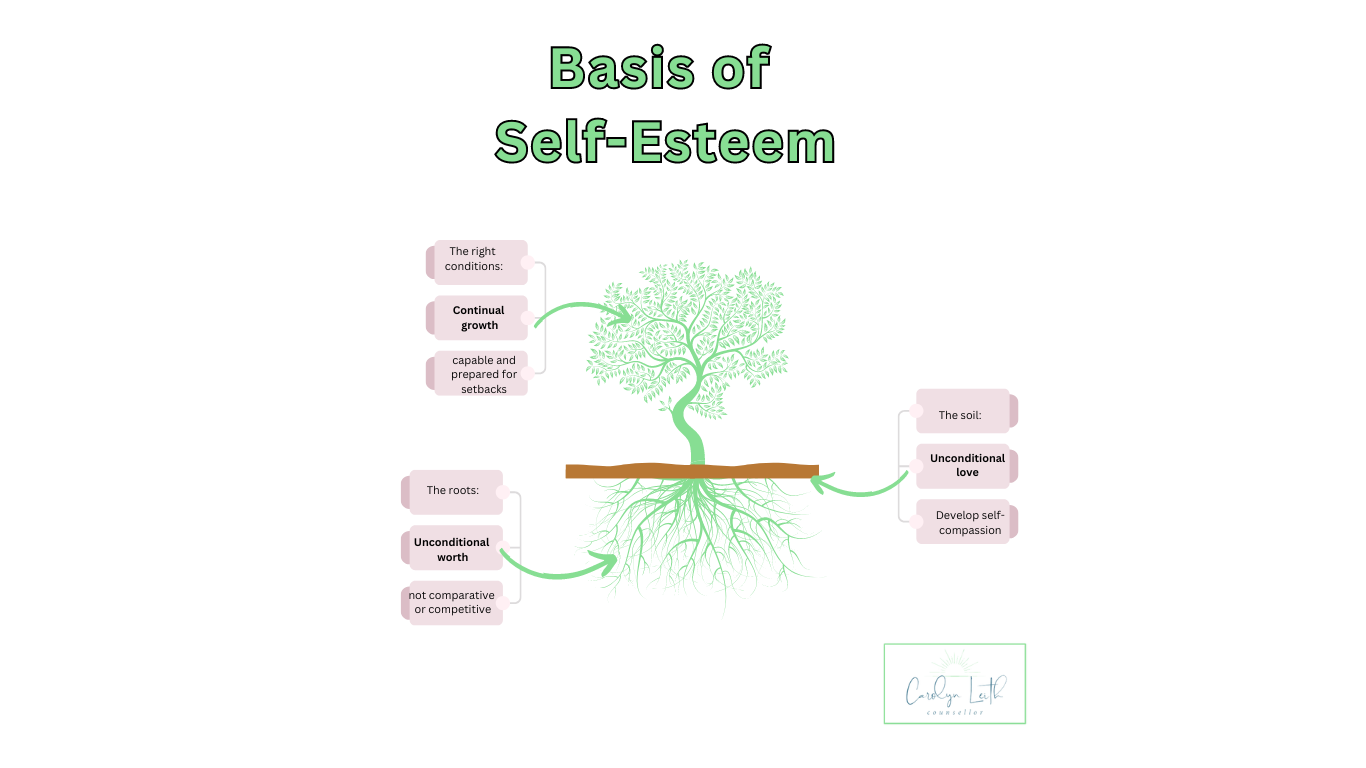
If we break self-esteem down into 3 component parts: unconditional worth, unconditional love and growth, it provides more concrete areas that you can explore to help you to develop actionable steps to raise your level of self-esteem.
The Pillar of Unconditional Worth
Our worth is unconditional – while you might see that for other people, sometimes you might feel like you’re the exception to the rule. If this resonates with you, then exploring this topic could be helpful. A good place to start is Howard’s Law of Human Worth based on the work of Claudia A Howard (1992) it states that:
All have infinite, eternal, and unconditional worth as persons.
All have equal worth as people. Worth is not comparative or competitive.
Externals neither add to nor diminish worth. Worth as a person, is infinite and unchanging.
Worth is stable and never in jeopardy even if someone rejects you.
Worth doesn’t have to be earned or proved. It already exists. Just recognize, accept and appreciate it.
The Pillar of Unconditional Love
The next stage is unconditional love, quite often we are subjected to conditional love which means that we have to perform in a certain way and achieve certain external things in order to maintain a feeling of love. When we can detach our sense of self love from the need for qualification and we learn to speak to and treat ourselves in a kind manner then we build a stronger foundation of self-esteem than we do when we use negative judgement. If you live with a strong inner critic, harshly narrating your life, ask yourself: in what ways does this help me? And question, how does that leave me feeling? Maybe it's time to try and foster a kinder, more gentle voice. Kindness does not equate to weakness and often through being kind you allow yourself more opportunities because if things don't work out, you will be more capable of grounding yourself and accepting your shortcomings.
The Pillar of Continual Growth
It is from this foundation that the third stage of self-esteem can be more easily pursued. Unconditional worth and kind acceptance offer a supportive position from which you can step outside your comfort zone, pushing yourself in different areas of your life to increase your circles of mastery and increase your feelings of being confident and capable. The opposite of continual growth is that feeling of being stuck in a rut and you aren’t moving forwards, this stagnation is often accompanied by feelings of low self-esteem. It’s as though by stretching your abilities and challenging yourself you improve your levels of self-esteem, even setbacks can be viewed as learning curves and you maximise your opportunities.
If you struggle to get out of your comfort zone, a deep dive into the work of Carol Dweck and her explanation of the growth mindset is a really helpful concept to support you.
Working on your self-esteem in this way is proactive and far less conditional. Rather than your self-worth rising and falling depending on how confident or successful you feel, your inherent worth is no longer on the line. This allows you to accept yourself as you are, and to view setbacks not as evidence of failure, but as useful information you can learn from and grow through.
How Counselling Supports Self-Esteem
Counselling can support self-esteem by offering a consistent, non-judgemental relationship where you are not required to perform, achieve, or get things “right”. Many people with low self-esteem have spent years feeling evaluated — by others, or by their own inner critic — and counselling can be one of the first spaces where acceptance is not conditional.
Through counselling, you can begin to explore where your self-beliefs were formed, how you learned to relate to yourself, and where you may have absorbed expectations or values that no longer truly fit. This process can help you reconnect with what matters to you, rather than living primarily in response to external approval or fear of judgement.
Counselling also provides a supportive environment to gently experiment with new ways of thinking, feeling and behaving. By developing grounding skills, emotional awareness and self-compassion, you can begin to challenge self-limiting beliefs, step outside your comfort zone, and relate to yourself with greater understanding and confidence over time.
If you are interested in having counselling, and would like to know more about how I work, arrange a free introductory call by emailing contact@carolynleith.co.uk